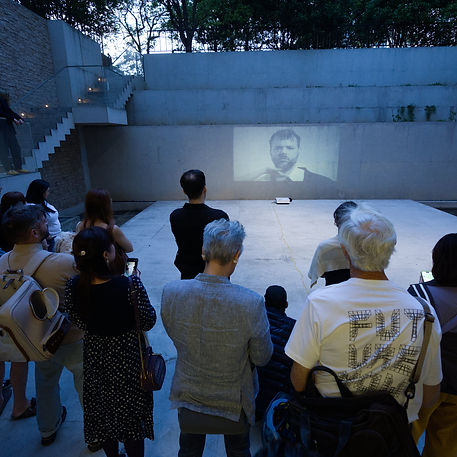
Ist das etwa Kunst, Mateja Ristic?
Video performance
2025
The video performance functions as a tribute to Raša Todosijević and his canonical work Was ist Kunst, Marinela Kozelj?, which at the time of its creation acted as a radical provocation directed toward institutional structures. That work established key coordinates of conceptual and performance art within both the Yugoslav and broader international context. Artists of that period were rarely granted institutional recognition, and it was precisely this position of marginality that enabled the articulation of a fundamental question: what is art and who holds the authority to define its value?
Drawing from this historical framework, the present work reintroduces the question “Is this supposed to be Art?” within a contemporary social context in which institutions, artists, and audiences increasingly find themselves disoriented between aesthetic indeterminacy and commercial opacity. In such conditions, art is often accepted as a given fact rather than treated as a field requiring continuous reflection on its function and social responsibility.
In Todosijević’s original work, the artist interrogates his wife, Marinela Kozelj, who remains a silent observer and symbolically represents the passive position of the audience in relation to artistic authority. In this performance, that relationship is deliberately reversed. The artist’s wife assumes the active role of the subject and interrogates the artist himself, thereby destabilizing the traditional hierarchy between author and viewer, subject and object.

Information overload, 2026
Mixed media: acrylic on canvas
150 x 150 cm (59.06 x 59.06 inches)
The work raises the question of whether the artwork is the act of performance itself or whether, within an expanded conceptual register, the artist becomes the artwork. This provocation is directed toward the contemporary position of the artist as a recognizable figure within the attention economy, where visibility and recognizability frequently outweigh the artistic work itself as criteria of value. The question of whether the artist becomes art is not presented as a claim, but as an open challenge intended to prompt reflection on contemporary cultural hierarchies.
The physical dimension of the performance, including the exposure of the body, its marking with paint, and the act of cutting hair, functions as a metaphorical reflection of the artist’s position as a subject of symbolic and economic extraction. Institutional systems often do not operate as support structures, but rather as hierarchical mechanisms that condition and shape artistic practice. Within such a framework, the artist becomes exposed to market logic, while aesthetic and ethical criteria are displaced in favor of recognizability and self-promotion.
The work also implicitly raises the question of acquiescence. Why does the artist accept such a relationship and so rarely challenge it? This mechanism is deeply internalized through the idea of galleries and museums as temples of art, to which unconditional respect is granted. That position of authority is frequently instrumentalized for the reproduction of institutional power rather than for a shared cultural purpose.
The fact that the performance is executed in a single uninterrupted take, without editing or the possibility of correction, carries both aesthetic and ethical implications. Error is not eliminated but becomes an integral part of the work, affirming the authenticity of the process and rejecting the illusion of total control and perfection.